Showing posts with label shopping. Show all posts

Saturday, August 2, 2014

Life in a Mini

Bunker Bay, WA


The last time I blogged here was six months ago, which coincides with me moving from Perth to Bunbury (175km south) for six months. I can't explain the lack of blogging during that time - it might have been distraction by work, hanging out with new friends (including housemates!), making the most of my time "down South" by travelling, or general despondency about political events during that period. While I was away, I was staying in furnished accommodation provided by my employer, while a friend house-sat for me in Perth.

What struck me on arriving home yesterday, with six months worth of life (clothes, toiletries, bedding, towels, exercise equipment, books, cleaning equipment, kitchen essentials, computer, lamp, radio, wooden coathangers) easily stacked in the back of my small car (a baby blue, 2-door Mini Cooper) is that I was returning home to an apartment empty of people but overflowing with my stuff.

My wardrobe was overflowing, even though all of the clothes I'd worn for the previous six months (in my own version of Project 333) were still sitting in bags on the living room floor. The bathroom counter was similarly overflowing with half-used make-up bottles, brushes and toiletries (but not hair elastics - I can never find them when I want them) despite the fact that I had a full complement in my suitcase waiting to be unpacked. Most of the items waiting to be unpacked had travelled from Perth to Bunbury and back again. In fact, only a few of the items I brought back from Bunbury were new - bathers (Aussie made), some pottery I made in a beginners' class (ah -that's what I was doing instead of blogging), a pair of warm boots, a warm blanket, some warm slippers (do you see a theme?), pillows (Aussie made of course), some gifts from workmates, two new artworks, and some food and wine I picked up on my travels.

The upside is that most of the clothing, shoes, accessories, toiletries, bedding, etc that I abandoned for the last six months will be leaving the house to allow for a much more minimal wardrobe. I have no desire to shop for anything new (besides books...although I am getting better at giving away ones that I've read) and am already dreaming about the extra space in my apartment...remaining empty.


Saturday, January 4, 2014

Not resolving, just doing

I am working on a review of my 2013 resolutions.

I don't have resolutions for 2014 but am trying a bit of this, a bit of that, and this too. You may also wish to try these.

I will also do this and this, which I already do anyway but should do more publicly now that it has a higher profile. I'll write more about these in future.

It's seems particularly pertinent due to the news today that striking garment workers in Cambodia were shot dead by police.

Sunday, October 13, 2013

Sunday links


I'm a big fan of the older crowd - I am inspired by their stories and wisdom. Fabulous Fashionistas is a British documentary about six such inspiring women, with average age of 80.

Tim Minchin gave a great graduation address at his old (and my old!) university. You can read the transcript here or watch it here. I would tell you my favourite parts but it's all good. Fantastic advice for life.

Australians are the richest people on Earth! Based on median wealth, that is. However, most of the growth in income goes to wealthiest, not those who need it the most. There is an increasing body of evidence (admittedly, small psychology studies) showing that wealthier people tend to be less nice people.  The world's richest woman (and fellow Western Australian) Gina Rinehart is an exception, if her lawyer is to be believed. He recently told the NSW Supreme Court that she's "...so selfless that she could not retire or pour her billions into philanthropy." (Sydney Morning Herald "Rich people couldn't care less", "The biggest victim here is Gina, says her lawyer"; ABC Dr Karl's Great Moments in Science "Greed is not good")

Meanwhile, "Moneyless man finds happiness", about the guy who started Freeconomy and has lived without money for the past five years. The comments say it all. (ABC Environment)

And from the sublime to the ridiculous, a look inside a temperature-controlled warehouse that stores clothes and accessories for the ridiculously rich, including Ivanka Trump and Gwyneth Paltrow. (Mail Online)

More "fashion": scrunchies and perceived obsolescence. (Waste Not)

Also, in case you're wondering, Buy Nothing New Month has been very easy so far. I browsed a few op shops but didn't buy anything. Unlike last year, I am allowing myself to buy groceries but I am not buying any staples or bulk items, just fresh produce. I think I need to follow up with "Get Rid of Heaps of Shit" month. There's so much more to share but I have to go deal with a silverfish problem.


Sunday, September 22, 2013

Sunday links

American ex-pat Traveling Mama was scolded by her daughter's Danish school for slipping a cookie into her lunch box. Isn't that a great message to send kids - sugary foods are for special treats only.

Speaking of sugar... "Sugar Love: A Not So Sweet Story." - National Geographic

A beautifully edited movie about the sad consequences of plastic pollution - People Should Know About This Awful Thing We Do, And Most Are Unaware on Upworthy

The Noise of Stuff. It stops me from sleeping sometimes - Ooomf

Everyone buys too many clothes... - Perth blogger Treading My Own Path

The American Edit agrees, and quotes the same Vivienne Westwood piece, "Buy less, choose well..." - The American Edit

On a similar topic, "Unseeing what's really on sale" -  Victoria Mason Jewellery


Monday, June 3, 2013

Sunday links


Times Haiku: Serendipitous Poetry from the New York Times
This New York Times piece talks about the power of citizen lobbying and the hurdles that citizen lobby groups must overcome. In the words of Captain Planet, "The power is YOURS."


One of my first posts on this blog was about the Peter Singer book, The Life You Can Save. In his recent TED talk on Effective Altruism, he argues the ethics behind that book. I think it's worth 20 minutes of your time.

Bigger Than Yourself is starting a letter-writing campaign to Australian fashion labels, asking about the ethics behind their clothing production. She's starting out with popular brands Sportsgirl, Review, Portmans, Alannah Hill and Witchery and she's had a few typically vague responses. I'm going to write to a few of the brands I no longer purchase because I'm not confident they're sweat-shop free.

Three Australian-based, ethical fashion/lifestyle blogs I discovered this week: Indigo Bazaar, Green Flings and Eco Warrior Princess.

One of my food heroes, Hugh Fearnley-Whittingstall, is heading to Australia for a River Cottage Australia. Unfortunately, it's on Foxtel. I may need to find a friend with Foxtel...or wait until it comes out on DVD. I'm hoping there will be a River Cottage Australia cookbook.

Another of my food heroes, Michael Pollan, was on ABC Radio National this week along with celebrity chef Peter Kuruvita and "Salt Sugar Fat" author Michael Moss. They talk about taking back control of cooking (from food corporations) as a source of pleasure and self-reliance. (Thanks to @timsenior for the link.)

Fat City: What can stop obesity? is a long, but eloquent and thorough, read by Australian physician Karen Hitchcock. (Illustrated by a faceless fatty, I see.) She discusses the individual and societal factors leading to obesity, and the costs to the individual and to the public.  She concludes, "If you come to me, your doctor, and you ask me to make you thin, for now I will have to cut you or drug you, as these are the only weapons I have to ward off the sirens." We (not just doctors but everyone) need to tackle obesity at a societal level because as Dr Hitchcock says, our options are limited at an individual level.
 
Please comment if you find these links of interest and would like to discuss their content.


Tuesday, May 7, 2013

March - April update

This is a regular update where I summarise my progress with my 2013 ethical resolutions.

I'm doing pretty well with some of my resolutions. I've kept up regular charitable donations and made additional one-off donations, I'm doing my best with Michael Pollan's food rules and my meat free days, and I only buy free-range or organic meat. I don't always stick to this when I'm dining out and someone else orders - this is somewhere I can improve. I continue to use my Shop Ethical! app whenever I am buying an unfamiliar grocery item or brand.

However, I definitely need to eat at home more often (and I'm hoping for some inspiration from the new Michael Pollan book, Cooked). I am yet to host a clothes swap party or have another self-inflicted "Buy Nothing New Month". I still need to buy a bicycle (which my parents are giving me as a birthday gift). I haven't tried growing anything on the balcony and I obviously haven't been blogging here once a fortnight. I have had a guest staying with me the last couple of months so my electricity use has actually doubled and presumably my water consumption has also increased. My exercise levels have stayed pretty stable and I continue to suck at getting enough sleep.

I still have piles of things to give away but I haven't managed to move them out of my apartment. A friend has asked me to join her in a garage sale so I might try to sell some of the more valuable items and donate the proceeds to charity.

I feel as though I have been buying less but it still looks like a lot when I list everything I bought in the last two months. My (non-food, non-medication/-hygiene) purchases for March and April include:
  • scarf by Otto and Spike (on sale, from one of my favourite local stores, William Topp).  Otto and Spike use surplus yarn and wool from industry to make gorgeous knitted accessories in the Melbourne suburb of Brunswick. They have a wonderful story that you can read here.
  • cut flowers from the farmers market. I love having cut flowers in the house but in the hot Perth weather they don't last very long. Native flowers are the best, especially when from my mum's garden.
  • a new ball point pen. My other pens had all disappeared and I need a pen for work. Mainly to write prescriptions, it would seem. It's probably made in China but I didn't have time to shop around for an ethically sound pen. My consolation with this one is that it takes refills and that it's from an Australian company.
  • cleanser and eye serum from Aesop. I've written before about my love of Aesop. The cleanser I use every day and will probably last me a year. The eye serum was a more questionable purchase - I didn't check the price before I bought it and I have only used it a few times (due to my sucky sleeping habits). I will try to use it more often and justify the expense. I will write about the beauty industry and anti-ageing products in future.
  • Aussie-owned, Aussie-made organic laundry detergent and some NZ-owned, NZ-made stain remover. The former unfortunately has an overpowering lavender scent. Again, I must take the time to learn how to make my own cleaning products.
  • Aussie-owned, Aussie-made products to combat silverfish that I have been finding around my bathroom (not the wardrobe, strangely). Obviously, I don't want silverfish to shorten the lifespan of my clothing. The Hovex products are not nearly as nice as my clothing protectors from Thurlby Herb Farm, which is a Western Australian company that supports its local community in South West WA.
I also bought a few gifts in April but as I have been too slack to wrap and send them, I had better not list them here in case the recipients read this blog post. 


Sunday, March 3, 2013

February update

In February, I was busy living (ethically, I hope) rather than blogging. My resolution to blog here at least fortnightly was over-ambitious. However, I will continue to summarise my progress with the other ethical resolutions.

I increased my regular charitable donations to keep donations at least 5% of my income.

I am doing fairly well with my food-based resolutions (eating less meat, eating only free-range meat, buying from independent grocers and farmers' markets, following Pollan's Food Rules, using the ShopEthical! app) except that I started a job that involves a lot of driving and subsequently started buying a diet cola, sparkling water and takeaway coffees. To combat this, I purchased some coffee to make in a plunger at home (Organic Frida by Republica) and a water bottle that will keep my water icy cold, even after being left in the car on a 40C day.

Speaking of purchases, I made a few this month (as well as food, drink and medication). These were:


  1. A vintage beaded blouse
  2. Three make-up items from Aussie brand Australis (I will post about make-up in future), for a burlesque-themed party I was attending;
  3. My new S'Well water bottle (from one of my favourite local independent stores);
  4. Dishwashing liquid (must learn how to make my own);
  5. A vehicle logbook (Australian-made by an Australian-owned company) for my new job, for which I am driving up to 200km per day; and
  6. A baby-blue, second-hand pushbike car.
That's right - I was supposed to write about choosing a bicycle and instead I spent my vehicle-buying energies choosing a car.  Ugh. That's another post altogether.

Did you make any ethical resolutions for 2013? How are they going?

Thursday, January 31, 2013

Buying (nearly) nothing new - January 2013

I recently read that all social media, especially blogs, are inherently narcissistic. I will be doing a narcissistic post at the end of each month this year in an effort to make myself accountable for my "easy, ethical 2013 resolutions". This month I will focus on "stuff" because that is where I made the most change.

I have purchased two new "things" this month (not including food, drink, services or medication). One was a light globe to replace a blown globe in my storage room, which receives no natural light. I make no apologies for that. I am really proud that I resisted buying anything at the local handmade markets (my shopping Achilles heel), bookstores and post-Christmas sales.

My other purchase was a modem, after my modem stopped working last weekend. I tried to use an old one of my Dad's but it didn't work. I had no idea how best to choose electronics from an ethical perspective, other than avoiding them. I should have chosen to do without a modem. I could have looked for one for sale secondhand or on Freecycle. However, I use my broadband for work and study (plus watching TV and narcissistic blog posts) so decided to replace my modem within a couple of days of it dying. My first instinct was to head to the discount electronics superstore across the road. Instead, I paid a visit to a family-run computer store in the next suburb. The advantage? I saved time choosing which modem to buy, as they only had one model in each speed. I didn't waste time searching product review sites on my phone. I received great service. The whole transaction took about 5 minutes, instead of the 30+ minutes I would have spent agonising over the choices at the chain store. I supported a local business and I saved 30 minutes of my time. (I still have the two useless modems sitting around, waiting for electronics recycling collection time.)

I have been working at my "giving away 7 items per week" goal. I've only given away a few items but I've identified dozens that will be given away shortly. I am in the process of clearing out my wardrobes (that's right, I have a completely unnecessary TWO wardrobes for one person) that are shamefully full of clothes I had forgotten I owned and shoes I have not worn for years. Some of the shoes have only been worn once. I even hoarded some of the empty shoeboxes! I discovered bags full of clothes that I had intended to donate to charity in 2011 and had shoved in the top of my wardrobe, awaiting the annual charity collection. The charity collection never eventuated and the bags are still there, of no use to anyone. Most of the items will go to the Red Cross and I hope some will find a new home at Ready to Work, a local charity that helps disadvantaged women find employment.

Some of my sad, unloved shoes. They want a new home.
I have also been clearing out the kitchen cupboards of tools I never use and discovering products that I should use. It is helping to make my little kitchen work more efficiently and will help me cook more and follow Pollan's Food Rules.

I feel that I haven't challenged myself in January and will try to make more of a difference in February. My parents are getting me a bicycle for my birthday and that will be the topic of my next post. Yippee!


Friday, December 7, 2012

Buying Christmas gifts? My gift guide.

I have decided to throw in my 2 cents (more like $200, at current Perth prices) with a Christmas gift guide. There's a wealth of links here about how to simplify your Christmas, including Zen Habits' Case Against Buying Christmas Presents. A sobering statistic from The Life You Can Save newsletter:

"According to the National Retail Foundation, last year, $563 billion dollars were spent just in the U.S. during the holidays in 2011. To put that in perspective, according to a UN report, the cost of reducing by half the proportion of the world’s population in extreme poverty will be $189 billion dollars in 2015."

However, if you are going to buy gifts (as I am), my first suggestion would be to make a charitable donation on behalf of the recipient - for example, Oxfam Unwrapped's Pile of Poo (or any of their other excellent gifts for the less faecally-inclined). As well as helping Oxfam's humanitarian projects, you can claim the donation as a tax deduction! Win-win.

If your recipient just wouldn't be satisfied with a donation, think about gifting an experience. Depending on your budget, options include a holiday, birdwatching, a voucher for a local independent restaurant, some babysitting or a cooking class. A voucher for shoe repair or a tailor would allow them to rejuvenate old shoes and clothes, to stop them going to landfill.

If you must give a more tangible gift, keep in mind the resources (environmental and human) that went into producing the gift. Fair trade items tick the box here (try the Oxfam shop or if in Perth, Fair Go Trading in Northbridge). If you're buying for a sweet tooth, there's a lot of delicious fair trade chocolate about (Fair Go have a Butter and Sea Salt chocolate that I really want to try - hint to any family or friends reading).

You can also head to local markets for locally produced items. Some of my upcoming favourite Perth holiday markets include Unwrapped Designer Market (Sundays December 9th and 16th in Forrest Place), Subi Farmers Market Annual Christmas Gift Market (Saturday December 8th, 8am to noon) and Illuminites Christmas Festival (Friday December 14th, 5pm to 10pm, Perth Cultural Centre).

Support your independent bookstores by giving books as gifts. Be subversive with beautiful coffee-table books with an underlying message of sustainability. I recommend Kevin McCloud's 43 Principles of Home, Amanda Talbot's Rethink: The Way You Live, Michael Pollan's Food Rules (beautifully illustrated by Maira Kalman) or India Flint's Second Skin.

Some other thoughtful gift guides I recommend are Nicholas D. Kristof's Gifts That Change Lives for the New York Times (charitable donations), GiveWell's Top Charities for the 2012 Giving Season (also donations), Oxfam's Top Ten Gifts (all fair trade) and Sarah Wilson's Christmas Gift Guide.

If none of the above will satisfy, I recommend something from Aesop. Unlike mainstream beauty companies, this fiercely independent Australian brand puts most of its money back into research and development, rather than advertising and promotions. They don't have sales, which is a good indicator that their products don't have ridiculous mark-ups. The products are all made in Australia and they do what they promise on the label, in addition to looking great in the bathroom and smelling divine. They're expensive but they last for months (and then some). As a universally pleasing gift, I would recommend the Resurrection Aromatique Handwash. Every time your gift recipient uses it, or spies it next to their sink, they will sigh with pleasure and think of you with fondness for bringing it into their life.

What are your recommendations for ethical gift-giving?

Tuesday, November 27, 2012

Cheap fashion - what does it cost?

We have an insatiable appetite for cheap fashion. I've heard friends say, "This store is great for throwaway clothes." I've seen fashion magazine covers scream, "Guilt-free buys under $20." I've seen a lifestyle journalist comment (repeatedly) that fashion purchases are so cheap, they're "practically free."

These comments assume that the only cost of cheap fashion is the cost to our wallets and that the only reason we may feel guilty about purchasing cheap fashion is that we're spending our potential savings or racking up more credit. The Australian mainstream media today ran a "cheap fashion" story, with the long (and poorly punctuated) title "The twin test: One twin is wearing a $199 Cue dress the other is in a $50 Target dress. Can you tell the difference?" The focus of the article was the aesthetic differences between the two dresses - the fit, the cut and the feel of the fabric. While mention was made of the country of manufacture (the $199 dress is made in Australia by an accredited Ethical Clothing Australia brand, whereas the cheaper dress is a cotton/elastane mix and was made in China), no comment was made about the possible implications for labour conditions.

One reason the "Twin Test" article resonated so much with me today is that it was juxtaposed against the horrific news of more than one hundred deaths in a factory fire in Bangladesh. Twelve of those people died after jumping from windows to escape the fire (due to a lack of emergency exits). I'm not trying to suggest that the cheap Target dress in the article above is linked to factory worker deaths, or even that Target uses factories with unsafe labour practices and conditions. Target Australia, like many big brands, has an Ethical Sourcing Code, which is very easy to find and download from their website. This is self-monitored, as per the guidebook to their code:

"Target will monitor compliance with this Code, and we, or our representatives, may visit factories to ensure compliance with this policy. Any violations of our Code will be reported to the vendor for follow up and corrective action. Vendors are required to cooperate with the entire process. Where there are egregious violations and/or the vendor/factory does not demonstrate a willingness to comply, Target reserves the right to discontinue business with the vendor/factory."

This monitoring seems pretty wishy-washy to me. They "may" visit factories to ensure compliance, they "reserve the right to discontinue business" in the case of "egregious violations." I'm not trying to pick on (or target) Target in particular. I only mention them because they are featured in the "Twin Test" article and I thought they would be fairly representative of other big Australian retailers. (Out of interest, I spent a few minutes searching the Myer and David Jones website but was unable to find any ethical sourcing policy, just mentions of their philanthropic works. K Mart has an Ethical Sourcing Code, similarly worded to Target's, which is unsurprising as they are both subsidiaries of the same company. I could not find a similar policy on Big W's website.)

What I am saying is that our appetite for cheap fashion, and retailers' desire to feed that appetite, means that manufacturers have to produce garments more and more cheaply. This inevitably means that somewhere along the line, corners are cut, and the least empowered workers are the ones who ultimately suffer. Most (nearly all) big labels and chain stores out-source the production of their garments to third parties. This way, when disasters such as today's factory fire occur, the label can protect their brand name and wash their hands by severing their ties with that factory and condemning its unsafe practices.

How do you ensure that the people who made your fashion did so in a safe working environment, under fair conditions? Unfortunately, this sort of information does not appear on a clothing label along with the washing instructions. There is nothing to distinguish whether it was made in a "good" or "bad" factory. When I'm in a store and spot clothing I like, the first thing I look for is the place of manufacture (yes, even before the price). Unless it's made locally or fair trade, I will avoid it. Individual items of clothing may be more expensive but I am buying far fewer clothes than previously. The only way to ensure that workers are treated fairly is for consumers to demand it and to be willing to pay more for fashion that is produced under better conditions.

Even the "Twin Test" article concedes, "...cheap clothing can often cost more in the end because enthusiastic bargain-hunters buy more items than they really need." It's a pity the more important, human, cost is not mentioned.


As usual, this post is longer than I intended, with half the content. Another post on this topic, and a page with reading suggestions, coming soon!

Sunday, November 25, 2012

Buy Nothing Day


Today was Buy Nothing Day. I bought nothing. I feel that I cheated a little, in that I didn't go near any retail or entertainment districts. However, yesterday I did brave the one day sale "event" of the big department store here in Perth. Whereas in previous years I would have fallen victim to heavy discounts on electronics, manchester, luggage, cosmetics and fashion, yesterday I just felt a bit ill about joining in the consumer frenzy and accumulating more stuff. I am finding it very easy to avoid buying new clothes, as I am currently reading To Die For: Is Fashion Wearing Out the World? by Lucy Siegle, about the environmental and human costs of garment production - not only of cheap, "fast fashion" labels but also of luxury brands.  I thought I already had pretty strict criteria for new clothing and accessory purchases (ethically made in Australia, made in a developed country or fair trade) but reading about the cotton and leather industries has put me off completely. 

Even staying away from stores today, I was bombarded via my RSS feeder to SAVE SAVE SAVE in online Black Friday sales from the USA. Black Friday sales occur in the USA (and even Canada) on the day after American Thanksgiving - Friday 23rd November this year. (Buy Nothing Day coincides with Black Friday in North America, as opposed to other countries where it is held on Saturday.) This year, some big businesses commenced their Black Friday sales on Thursday (Thanksgiving). The Seattle Times interviewed some people who left their family celebrations early to line up for sales (probably to buy gifts for the same family members they've abandoned with the cold turkey). Consumers will have a little time to rest up over the weekend before the onslaught of Cyber Monday online sales (an event that Australia's big retailers tried, and failed, to emulate this week with "Click Frenzy" aka #ClickFail).

Buy Nothing Day is not the only protest against Black Friday. As I mentioned in my previous post, Occupy Christmas is a movement to encourage consumers to purchase from local, independent designers and retailers, instead of "big box" retailers and global brands. Small Business Saturday, the day following Black Friday, also encourages North American consumers to patronise their local businesses. (It was founded in 2010 by American Express - think what you will about that.)

Online lifestyle retailer Holstee are promoting the idea of Block Friday to replace Black Friday, encouraging consumers to be mindful of how they spend their money and "seizing an important chance to spend quality time with friends, loved ones, and ourselves". True to their word, Holstee take their store offline on Black Friday, to allow their staff to spend time with loved ones. (Discovered via Unconsumption.)

This year on Black Friday, there were multiple demonstrations outside Walmart stores, protesting for better wages and conditions for Walmart's employees. You can support them here via the Story of Stuff site. Time will tell whether pay and benefits for employees of America's big retailers, many of whom live under the poverty line, will improve.

As for me, I will be following up Buy Nothing Day by attending local handmade design markets tomorrow, followed by a community street festival. I don't think my wallet will stay closed for long but at least the purchases will be thoughtful.


Saturday, November 17, 2012

Occupy Christmas

A wise colleague told me earlier this year that we must "decry the rampant materialism" that has led to individualism.

The local TV news last night reported that there are 39 days until Christmas, then warned those us who have not commenced Christmas shopping that we had better start now. They also reported that residents of my state (Western Australia) are expected to spend $5 billion this Christmas (based on this report by the Australian Retailers Association). While I don't begrudge local retailers and producers a living, I do wonder how many Christmas gifts, decorations, cards and other purchases will end up in the bin long before next Christmas rolls around.

In 2012, Saturday November 24th is Buy Nothing Day. I first heard about BND via Adbusters magazine, which I used to read in Borders on Oxford Street. (Appropriately, I never purchased it.) BND is a protest against consumerism. It will be nearly impossible for most people reading this blog to buy nothing for one day because most of us are continuously paying things like rent, mortgage, insurance, utilities, education fees, phone bills and so on. However, it is possible to plan your day so you are not buying any food, drinks, fuel or "stuff" on BND.

A variation on BND is Occupy Christmas. This movement encourages us to purchase locally produced goods from independent retailers. Visit design markets, small independent stores and farmers markets and you won't be disappointed.

Will you give Buy Nothing Day or Occupy Christmas a go? I've found that participating in Buy Nothing New Month is still having a positive influence on my purchasing patterns.

I leave you with the words of the "world's poorest president", Jose Mujica of Uruguay, who decries the model of consumption in rich countries. He is interviewed in yesterday's BBC News Magazine:

"I'm called 'the poorest president', but I don't feel poor. Poor people are those who only work to try to keep an expensive lifestyle, and always want more and more. This is a matter of freedom. If you don't have many possessions then you don't need to work all your life like a slave to sustain them, and therefore you have more time for yourself. I may appear to be an eccentric old man... But this is a free choice."

Wednesday, October 31, 2012

Buy Nothing New Month - The End

My first attempt at Buy Nothing New Month is over. During October, I didn't buy anything new except prescription medication. I didn't even buy any groceries, instead eating out with friends and using up items in my pantry. (I may have inadvertently stolen a banana but that is unrelated.) I made one second-hand purchase, a $5 book. I was given a vintage trunk by my aunt, which used to belong to my grandmother. Browsing through my bank and credit card statements for October, I paid for travel and transport (a hotel for next month, fuel, public transport), communication (phone and broadband bills), meals, mortgage, charity donations and membership of Doctors for the Environment.

What have I learnt from Buy Nothing New Month?

It was unexpectedly very easy. Only once did I regret not being able to buy something new - a painting at an art show. However, I don't have any wall space for new artworks (due to previous binge purchasing of art) and it was an expensive painting so it worked out for the best.

I have too much stuff. I could go the rest of my life without buying anything new and still have too much stuff. This is probably why I buy lots of gifts for my friends and family, who probably also have too much stuff.

I waste a lot of time browsing stores. This often leads to purchases. Multiple times throughout the month I passed by stores and considered going inside but decided against it. Had I not been participating in Buy Nothing New Month I probably would have gone in and ended up buying something. I found this liberating and found I had more spare time to do other things.

It is far more enjoyable to dine out with friends than to eat alone at home. I should do it more often and support my favourite local restaurants serving local, organic and free range foods. Conversely, instead of buying lunch at work I am going to use up all those leftover meals in the freezer.

I am on multiple email and SMS marketing lists for stores. I received, and deleted, multiple invitations to "secret" or short-term sales events, special events and free shipping deals. These are all local or independent stores selling ethically produced products so I'm not going to unsubscribe from the mailing lists but I will think twice about purchases and avoid impulse buying.

Instead of purchasing new (or even used) items, I should try to borrow them or source hand-me-downs from family and friends. I've lived in this city most of my life so I have a large network of family and friends that have also accumulated much stuff (especially as my parents have a tendency to hoard). I needed a phone for a teleconferences (my cordless phone only has a 40 minute battery life, which is shorter than most of my teleconferences) and instead of buying a new phone, I discovered that my parents have an old "dinosaur" model they're no longer using and could give me. I wanted a new kettle after my electric kettle died so my mother found their old stove-top kettle that I now actually prefer to an electric kettle. I needed a small piece of luggage for a week-long work trip and borrowed it from my father. My mother has since offered to buy me my own for Christmas but it's not something I'd use more than a few times a year so I declined.

Some "collaboration" websites shared by Buy Nothing New Month:
openshed.com.au share tools, appliances, musical instruments and more with neighbours
airbnb.com find accommodation around the world
ziilch.com free to list and free to take
meemeep.com move stuff


When I told people (especially retail employees) about Buy Nothing New Month, they mostly reacted as if it was a hardship or punishment, consoling me with, "Oh, you poor thing!" I didn't find it that way at all. I found that it liberated my time, my money and my creativity. I definitely want to try it again in future for longer than a month.

If you'd like to try buying nothing, November 24th, 2012, is Buy Nothing Day. It requires more planning than Buy Nothing New Month but is still very achievable. More about that closer to the date!


Tuesday, October 30, 2012

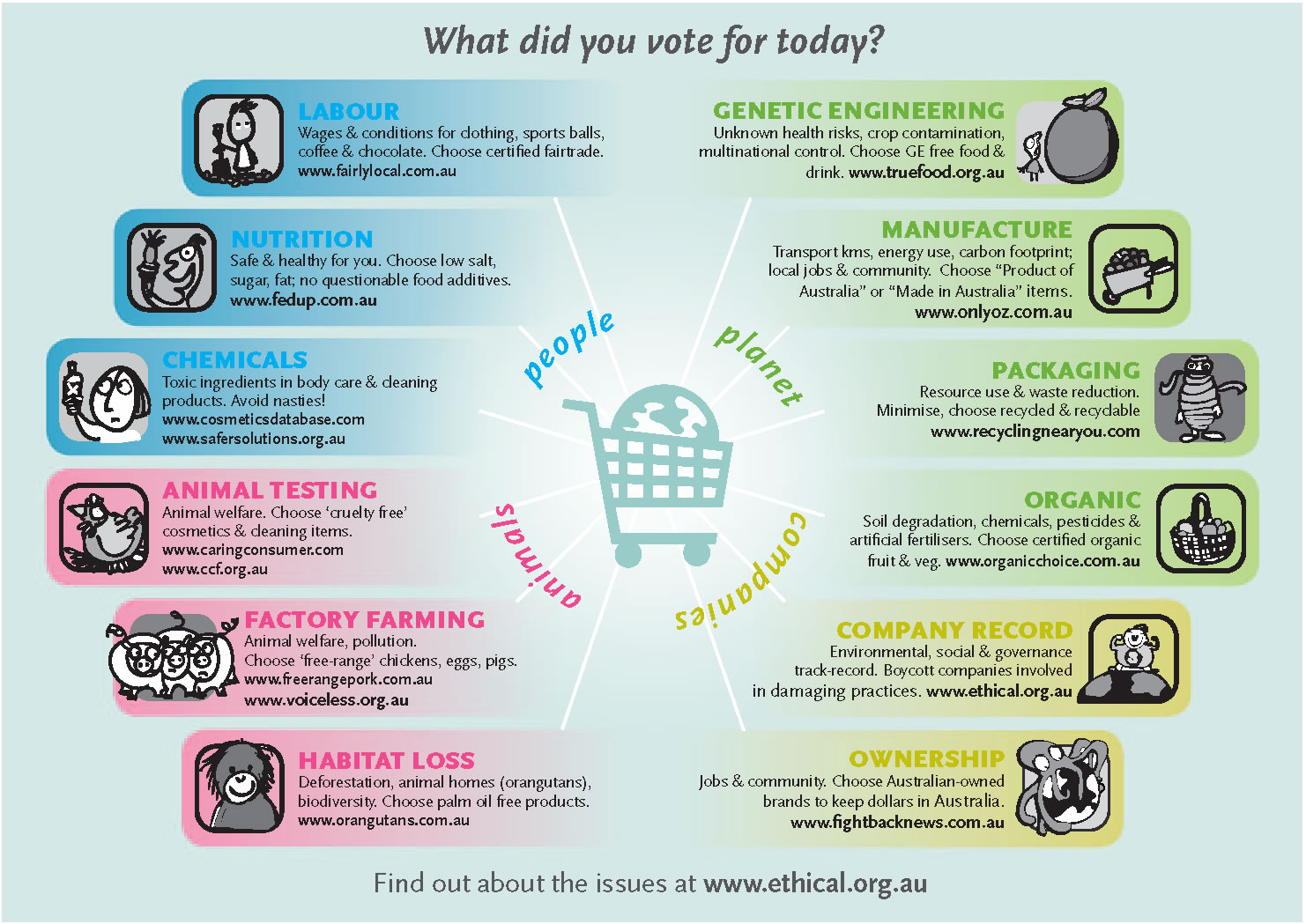
What I buy at the supermarket & how I "Shop Ethical!"

I'm a strong proponent of voting with my wallet. This is a general post about how I do that at the supermarket. There are many product categories available at supermarkets, each deserving of its own post (or series of posts) that I'll cover in future. These include food, toiletries and cosmetics, cleaning products, pharmaceuticals, clothing and textiles, and more.

I feel the two big supermarket chains in Australia have a real duopoly. (Gosh! I just googled it and Maggie Beer agrees in this article published online 30 minutes ago.) The "big two" lure us in with loyalty programs, loss leaders and discount fuel offers. They're big pushers of tobacco, alcohol and gambling. I try to shop at independent supermarkets, farmers markets, greengrocers, butchers and other independent retailers. When I do shop at the "fresh food people" or "down, down, prices are down" I'm careful to choose brands and products that I want to encourage them to stock more - local, Australian owned, organic and fair trade products. These products are usually found on the bottom or top shelf or inexplicably (in the case of organic hot chocolate and instant coffee), the "health food" aisle.

Making choices at the supermarket can be overwhelming. Packaged products are covered with all sorts of misleading labels trying to convince us of their health or environmental benefits. Marshmallows are "99% fat free"! Likewise, many "natural" products are neither healthy for us nor the environment. Many iconic Australian brands, like Vegemite and Tim Tams, are no longer Australian-owned. You may be boycotting Nestlé but not realise that they own Connoisseur ice cream (I can attest to this; the logo is very subtle).

One tool to assist supermarket decision-making is the Shop Ethical! app or its hardware form, the Guide to Ethical Supermarket Shopping book. I used the book before I had a smartphone but I find the app more convenient. I also get less weird stares from fellow shoppers. The app allows you to search for products via brand name or category. For each product, it offers information such as ownership, number of Australian employees, any boycotts, scores on various ethical shopping profiles, environmental pros and cons, treatment of employees and other ethical considerations. For each product, there is also an overall recommendation and you can quickly scroll through these for each product category. You can "favourite" products for quick reference.

I do not blindly follow the recommendations in the guide (eg sometimes I buy Green & Black organic cocoa, even though it is owned by Cadbury) but in most cases I agree with the recommendations and it makes my supermarket shopping much easier. If you don't follow the overall recommendations of the guide, there is enough information (and hyperlinks) to assist you in making your own decision about individual products.


Further reading:

Ethical Consumer Guide - the not for profit organisation responsible for the Shop Ethical! app
Dick Smith's Magazine of Forbidden Ideas "Censored by the Murdoch Press!"
Ausbuy, Australian Owned and Australian Made
Fair Trade Association, Australia and New Zealand
Australian Made, Australian Grown
Choice magazine's survey on country of origin labelling


This blog post is purely based on my opinion. I do not have any financial stakes in any of the companies or brands recommended and I am not affiliated with them, other than being a consumer.

Saturday, October 20, 2012

Buy Nothing New Month - Resources

Following yesterday's post about Buy Nothing New Month, here are a few links to help get started:
There are many more resources online - please share them in the comments!


Friday, October 19, 2012

Buy Nothing New Month


"We used to build civilizations. Now we build shopping malls."
BILL BRYSON

"Consumers have not been told effectively enough that they have huge power and that purchasing and shopping involve a moral choice."

ANITA RODDICK, BODY SHOP FOUNDER

"Too many people spend money they haven’t earned, to buy things they don’t want, to impress people they don’t like."

WILL ROGER

"People used to die of consumption. Then it went from being a fatal disease to a way of life"
ANON

"Advertising has us chasing cars and clothes, working jobs we hate so we can buy shit we don’t need." 

FIGHT CLUB, MOVIE BASED ON THE NOVEL BY CHUCK PALAHNIUK


This October I am participating in Buy Nothing New Month, a movement for collective, conscientious consumption that began in Australia's shopping capital, Melbourne.  I have pledged to buy nothing new this month, with the exception of food, drink and medications. I am allowed to buy second-hand goods and first-hand experiences. There are several reasons I decided to make the pledge. Firstly, to protest the rampant materialism that infests the developed world, making us selfish and numbing us to the plight of those who have less and those who suffer producing all our "stuff". Secondly, to raise awareness amongst my friends and colleagues about our wasteful lifestyles. Thirdly, to remind myself that just because something is ethically produced, it does not give me an excuse to buy it.

As someone who enjoys shopping (I will even confess to reading the inelegantly named Shop Til You Drop magazine), I thought that Buy Nothing New Month would be difficult. (I am particularly vulnerable to anything that's locally made, fair-trade, well-designed and from one of my favourite local independent stores - a particularly wanky kind of conspicuous consumption, I guess.) However, it has proven very easy thus far. 

I thought that a weekend in Melbourne would be particularly challenging. Happily, I enjoyed my spare time dining with friends and colleagues and browsing the small galleries and second-hand stores of Fitzroy. My single non-food, non-transport purchase of the month is a 1946 edition of George Bernard Shaw's The Doctor's Dilemma, from antique and vintage store 84 Smith Street. I've wanted to read this play for a while (it advocates doctors being paid a fixed salary, without any financial incentive to offer unnecessary treatment to patients - more on that another time) and I was very pleased to find it for five dollars.


I thought that a friend's birthday gift might prove difficult but I found a gift that I had bought for him a couple of years ago and forgotten about (I have a drawer full of such purchases), which I delivered to him in Melbourne, wrapped in some reused tissue paper. The Buy Nothing New movement also suggests gifting experiences or second-hand goods (like antique jewellery)!


Although I have bought food when I'm eating out, for meals at home I've tried to use up things in my pantry that would otherwise probably sit there until they were inedible. Brinjal pickle with wholemeal couscous was quite tasty (although somewhat lacking in greens). 


One thing I've observed is that when I stay at a hotel I am impeccable, aided by the small number of items I have with me. For the recent weekend in Melbourne, I used a handbag for luggage. For four days working in the Pilbara, a tiny wheeled suitcase was more than sufficient. This is in contrast to my cluttered, chaotic home, which is full of gifts I've never given, art I've never hung, books I've never read, DVDs I've never watched, stationery I've never used, half-empty toiletries, clothes I've forgotten I own, unused craft supplies, CDs I've never played, alcohol that has sat on the shelves for years (scandalous, I know), and unnecessary multiples of so many items that I couldn't name them all. During a particularly decadent phase a few years ago, I would buy new clothes when I ran out of clean clothes to wear to work. I didn't even realise I was doing it until my mother pointed it out to me.


What have I learned from Buy Nothing New Month so far? I've become more aware of things I want to purchase, don't really need, but justify by telling myself that I'm supporting a small business or an ethical producer. I've become more creative with food and outfit choices. I've picked native flowers from my mother's garden instead of buying bunches from the florist that usually die within a few days. I've been catching up on some of those unread books. I've halted the ridiculous flood of gifts for my 10-week-old niece. At no time have I thought twice about something I didn't buy, or rued a lost opportunity. I haven't wasted any time browsing department stores. I chose vintage stores over the discount mall patronised by my colleagues when we were in Melbourne.

I think I need to extend Buy Nothing New Month into Buy Nothing New Quarter. That would provide a real challenge and force new behaviours, such as joining the library, using up those craft and baking supplies for the holiday period, finishing those unread books, "shopping the closet" and getting old shoes repaired. I would spend more time creating, spending time with family, making my way through the never-ending "To Do" list and not accumulating stuff.


Who wants to join me?


See Part 2 for Buy Nothing New resources

Quotations above via Buy Nothing New Month website