I am working on a review of my 2013 resolutions.
I don't have resolutions for 2014 but am trying a bit of this, a bit of that, and this too. You may also wish to try these.
I will also do this and this, which I already do anyway but should do more publicly now that it has a higher profile. I'll write more about these in future.
It's seems particularly pertinent due to the news today that striking garment workers in Cambodia were shot dead by police.
Showing posts with label consumption. Show all posts
Showing posts with label consumption. Show all posts
Saturday, January 4, 2014

Sunday, October 13, 2013
Sunday links
I'm a big fan of the older crowd - I am inspired by their stories and wisdom. Fabulous Fashionistas is a British documentary about six such inspiring women, with average age of 80.
Tim Minchin gave a great graduation address at his old (and my old!) university. You can read the transcript here or watch it here. I would tell you my favourite parts but it's all good. Fantastic advice for life.
Australians are the richest people on Earth! Based on median wealth, that is. However, most of the growth in income goes to wealthiest, not those who need it the most. There is an increasing body of evidence (admittedly, small psychology studies) showing that wealthier people tend to be less nice people. The world's richest woman (and fellow Western Australian) Gina Rinehart is an exception, if her lawyer is to be believed. He recently told the NSW Supreme Court that she's "...so selfless that she could not retire or pour her billions into philanthropy." (Sydney Morning Herald "Rich people couldn't care less", "The biggest victim here is Gina, says her lawyer"; ABC Dr Karl's Great Moments in Science "Greed is not good")
Meanwhile, "Moneyless man finds happiness", about the guy who started Freeconomy and has lived without money for the past five years. The comments say it all. (ABC Environment)
And from the sublime to the ridiculous, a look inside a temperature-controlled warehouse that stores clothes and accessories for the ridiculously rich, including Ivanka Trump and Gwyneth Paltrow. (Mail Online)
More "fashion": scrunchies and perceived obsolescence. (Waste Not)
Also, in case you're wondering, Buy Nothing New Month has been very easy so far. I browsed a few op shops but didn't buy anything. Unlike last year, I am allowing myself to buy groceries but I am not buying any staples or bulk items, just fresh produce. I think I need to follow up with "Get Rid of Heaps of Shit" month. There's so much more to share but I have to go deal with a silverfish problem.
Sunday, July 28, 2013
Sunday Links
I have been thinking about what I would do with all my stuff if I moved away for a year or two. I could rent my apartment fully-furnished but what would I do with all my clothes? Books? Magazines? Liquor? Art? Fancy pieces of frippery? I would take very little away with me, which would leave the options of storing it, giving it away, loaning it out or trying to sell it. Giving it away is the most appealing option in terms of cost, time and effort. It definitely discourages me from accumulating any new "stuff". I've written a few posts on this subject before and I always go back to The Story of Stuff for inspiration (I highly recommend watching the original video if you haven't seen it before).
I come across many minimalism blogs (mostly American). People are trying to embrace a minimalist lifestyle for various reasons (financial, environmental and mental health, to name a few) across many aspects of life. Here's some recent finds on this theme:
I come across many minimalism blogs (mostly American). People are trying to embrace a minimalist lifestyle for various reasons (financial, environmental and mental health, to name a few) across many aspects of life. Here's some recent finds on this theme:
- Remember The New Joneses? They set up house in Melbourne's Fed Square during Buy Nothing New Month last year. For one week they had to find second-hand sources for life's necessities (and luxuries). The video explains it much better than I do.
- Ignoring the terrible grammar, I agree with most of the points in this article from Apartment Therapy.
- Erin from Design for Mankind questions her excessive (yet pretty normal for most women I know) wardrobe, illustrated by the beautiful sculptural fashion of Nadine Goepfert
- Wardrobe de-cluttering guides are pretty ubiquitous but I like this practical one from econest. (And if you do decide to buy some "new" threads, she follows up with this great guide to op-shopping from former Vogue Japan editor, Peppermint Magazine contributor and "Queen of Vintage" Leeyong Soo.)
- The uggly world of "Australian made" ugg boots - an interview with the only Australian-made ugg factory that tans its own sheep leather - ABC Rural, via my big sis
- Booming cashmere trade threatens snow leopards, wild yaks - of course, this article is plastered in pop-up ads for J. Crew, famous for their mass-produced cashmere - ecouterre
- Bangladesh Pollution, Told in Colors and Smells - New York Times
- Australians Are Getting Fatter - the New York Times perspective on our growing obesity.
Thursday, January 31, 2013
Buying (nearly) nothing new - January 2013
I recently read that all social media, especially blogs, are inherently narcissistic. I will be doing a narcissistic post at the end of each month this year in an effort to make myself accountable for my "easy, ethical 2013 resolutions". This month I will focus on "stuff" because that is where I made the most change.
I have purchased two new "things" this month (not including food, drink, services or medication). One was a light globe to replace a blown globe in my storage room, which receives no natural light. I make no apologies for that. I am really proud that I resisted buying anything at the local handmade markets (my shopping Achilles heel), bookstores and post-Christmas sales.
My other purchase was a modem, after my modem stopped working last weekend. I tried to use an old one of my Dad's but it didn't work. I had no idea how best to choose electronics from an ethical perspective, other than avoiding them. I should have chosen to do without a modem. I could have looked for one for sale secondhand or on Freecycle. However, I use my broadband for work and study (plus watching TV and narcissistic blog posts) so decided to replace my modem within a couple of days of it dying. My first instinct was to head to the discount electronics superstore across the road. Instead, I paid a visit to a family-run computer store in the next suburb. The advantage? I saved time choosing which modem to buy, as they only had one model in each speed. I didn't waste time searching product review sites on my phone. I received great service. The whole transaction took about 5 minutes, instead of the 30+ minutes I would have spent agonising over the choices at the chain store. I supported a local business and I saved 30 minutes of my time. (I still have the two useless modems sitting around, waiting for electronics recycling collection time.)
I have been working at my "giving away 7 items per week" goal. I've only given away a few items but I've identified dozens that will be given away shortly. I am in the process of clearing out my wardrobes (that's right, I have a completely unnecessary TWO wardrobes for one person) that are shamefully full of clothes I had forgotten I owned and shoes I have not worn for years. Some of the shoes have only been worn once. I even hoarded some of the empty shoeboxes! I discovered bags full of clothes that I had intended to donate to charity in 2011 and had shoved in the top of my wardrobe, awaiting the annual charity collection. The charity collection never eventuated and the bags are still there, of no use to anyone. Most of the items will go to the Red Cross and I hope some will find a new home at Ready to Work, a local charity that helps disadvantaged women find employment.
I have also been clearing out the kitchen cupboards of tools I never use and discovering products that I should use. It is helping to make my little
kitchen work more efficiently and will help me cook more and follow Pollan's Food Rules.
I feel that I haven't challenged myself in January and will try to make more of a difference in February. My parents are getting me a bicycle for my birthday and that will be the topic of my next post. Yippee!
I have purchased two new "things" this month (not including food, drink, services or medication). One was a light globe to replace a blown globe in my storage room, which receives no natural light. I make no apologies for that. I am really proud that I resisted buying anything at the local handmade markets (my shopping Achilles heel), bookstores and post-Christmas sales.
My other purchase was a modem, after my modem stopped working last weekend. I tried to use an old one of my Dad's but it didn't work. I had no idea how best to choose electronics from an ethical perspective, other than avoiding them. I should have chosen to do without a modem. I could have looked for one for sale secondhand or on Freecycle. However, I use my broadband for work and study (plus watching TV and narcissistic blog posts) so decided to replace my modem within a couple of days of it dying. My first instinct was to head to the discount electronics superstore across the road. Instead, I paid a visit to a family-run computer store in the next suburb. The advantage? I saved time choosing which modem to buy, as they only had one model in each speed. I didn't waste time searching product review sites on my phone. I received great service. The whole transaction took about 5 minutes, instead of the 30+ minutes I would have spent agonising over the choices at the chain store. I supported a local business and I saved 30 minutes of my time. (I still have the two useless modems sitting around, waiting for electronics recycling collection time.)
I have been working at my "giving away 7 items per week" goal. I've only given away a few items but I've identified dozens that will be given away shortly. I am in the process of clearing out my wardrobes (that's right, I have a completely unnecessary TWO wardrobes for one person) that are shamefully full of clothes I had forgotten I owned and shoes I have not worn for years. Some of the shoes have only been worn once. I even hoarded some of the empty shoeboxes! I discovered bags full of clothes that I had intended to donate to charity in 2011 and had shoved in the top of my wardrobe, awaiting the annual charity collection. The charity collection never eventuated and the bags are still there, of no use to anyone. Most of the items will go to the Red Cross and I hope some will find a new home at Ready to Work, a local charity that helps disadvantaged women find employment.
 |
| Some of my sad, unloved shoes. They want a new home. |
I feel that I haven't challenged myself in January and will try to make more of a difference in February. My parents are getting me a bicycle for my birthday and that will be the topic of my next post. Yippee!
Tuesday, November 27, 2012
Cheap fashion - what does it cost?
We have an insatiable appetite for cheap fashion. I've heard friends say, "This store is great for throwaway clothes." I've seen fashion magazine covers scream, "Guilt-free buys under $20." I've seen a lifestyle journalist comment (repeatedly) that fashion purchases are so cheap, they're "practically free."
These comments assume that the only cost of cheap fashion is the cost to our wallets and that the only reason we may feel guilty about purchasing cheap fashion is that we're spending our potential savings or racking up more credit. The Australian mainstream media today ran a "cheap fashion" story, with the long (and poorly punctuated) title "The twin test: One twin is wearing a $199 Cue dress the other is in a $50 Target dress. Can you tell the difference?" The focus of the article was the aesthetic differences between the two dresses - the fit, the cut and the feel of the fabric. While mention was made of the country of manufacture (the $199 dress is made in Australia by an accredited Ethical Clothing Australia brand, whereas the cheaper dress is a cotton/elastane mix and was made in China), no comment was made about the possible implications for labour conditions.
One reason the "Twin Test" article resonated so much with me today is that it was juxtaposed against the horrific news of more than one hundred deaths in a factory fire in Bangladesh. Twelve of those people died after jumping from windows to escape the fire (due to a lack of emergency exits). I'm not trying to suggest that the cheap Target dress in the article above is linked to factory worker deaths, or even that Target uses factories with unsafe labour practices and conditions. Target Australia, like many big brands, has an Ethical Sourcing Code, which is very easy to find and download from their website. This is self-monitored, as per the guidebook to their code:
This monitoring seems pretty wishy-washy to me. They "may" visit factories to ensure compliance, they "reserve the right to discontinue business" in the case of "egregious violations." I'm not trying to pick on (or target) Target in particular. I only mention them because they are featured in the "Twin Test" article and I thought they would be fairly representative of other big Australian retailers. (Out of interest, I spent a few minutes searching the Myer and David Jones website but was unable to find any ethical sourcing policy, just mentions of their philanthropic works. K Mart has an Ethical Sourcing Code, similarly worded to Target's, which is unsurprising as they are both subsidiaries of the same company. I could not find a similar policy on Big W's website.)
What I am saying is that our appetite for cheap fashion, and retailers' desire to feed that appetite, means that manufacturers have to produce garments more and more cheaply. This inevitably means that somewhere along the line, corners are cut, and the least empowered workers are the ones who ultimately suffer. Most (nearly all) big labels and chain stores out-source the production of their garments to third parties. This way, when disasters such as today's factory fire occur, the label can protect their brand name and wash their hands by severing their ties with that factory and condemning its unsafe practices.
How do you ensure that the people who made your fashion did so in a safe working environment, under fair conditions? Unfortunately, this sort of information does not appear on a clothing label along with the washing instructions. There is nothing to distinguish whether it was made in a "good" or "bad" factory. When I'm in a store and spot clothing I like, the first thing I look for is the place of manufacture (yes, even before the price). Unless it's made locally or fair trade, I will avoid it. Individual items of clothing may be more expensive but I am buying far fewer clothes than previously. The only way to ensure that workers are treated fairly is for consumers to demand it and to be willing to pay more for fashion that is produced under better conditions.
Even the "Twin Test" article concedes, "...cheap clothing can often cost more in the end because enthusiastic bargain-hunters buy more items than they really need." It's a pity the more important, human, cost is not mentioned.
As usual, this post is longer than I intended, with half the content. Another post on this topic, and a page with reading suggestions, coming soon!
These comments assume that the only cost of cheap fashion is the cost to our wallets and that the only reason we may feel guilty about purchasing cheap fashion is that we're spending our potential savings or racking up more credit. The Australian mainstream media today ran a "cheap fashion" story, with the long (and poorly punctuated) title "The twin test: One twin is wearing a $199 Cue dress the other is in a $50 Target dress. Can you tell the difference?" The focus of the article was the aesthetic differences between the two dresses - the fit, the cut and the feel of the fabric. While mention was made of the country of manufacture (the $199 dress is made in Australia by an accredited Ethical Clothing Australia brand, whereas the cheaper dress is a cotton/elastane mix and was made in China), no comment was made about the possible implications for labour conditions.
One reason the "Twin Test" article resonated so much with me today is that it was juxtaposed against the horrific news of more than one hundred deaths in a factory fire in Bangladesh. Twelve of those people died after jumping from windows to escape the fire (due to a lack of emergency exits). I'm not trying to suggest that the cheap Target dress in the article above is linked to factory worker deaths, or even that Target uses factories with unsafe labour practices and conditions. Target Australia, like many big brands, has an Ethical Sourcing Code, which is very easy to find and download from their website. This is self-monitored, as per the guidebook to their code:
"Target will monitor compliance with this Code, and we, or our representatives, may visit factories to ensure compliance with this policy. Any violations of our Code will be reported to the vendor for follow up and corrective action. Vendors are required to cooperate with the entire process. Where there are egregious violations and/or the vendor/factory does not demonstrate a willingness to comply, Target reserves the right to discontinue business with the vendor/factory."
This monitoring seems pretty wishy-washy to me. They "may" visit factories to ensure compliance, they "reserve the right to discontinue business" in the case of "egregious violations." I'm not trying to pick on (or target) Target in particular. I only mention them because they are featured in the "Twin Test" article and I thought they would be fairly representative of other big Australian retailers. (Out of interest, I spent a few minutes searching the Myer and David Jones website but was unable to find any ethical sourcing policy, just mentions of their philanthropic works. K Mart has an Ethical Sourcing Code, similarly worded to Target's, which is unsurprising as they are both subsidiaries of the same company. I could not find a similar policy on Big W's website.)
What I am saying is that our appetite for cheap fashion, and retailers' desire to feed that appetite, means that manufacturers have to produce garments more and more cheaply. This inevitably means that somewhere along the line, corners are cut, and the least empowered workers are the ones who ultimately suffer. Most (nearly all) big labels and chain stores out-source the production of their garments to third parties. This way, when disasters such as today's factory fire occur, the label can protect their brand name and wash their hands by severing their ties with that factory and condemning its unsafe practices.
How do you ensure that the people who made your fashion did so in a safe working environment, under fair conditions? Unfortunately, this sort of information does not appear on a clothing label along with the washing instructions. There is nothing to distinguish whether it was made in a "good" or "bad" factory. When I'm in a store and spot clothing I like, the first thing I look for is the place of manufacture (yes, even before the price). Unless it's made locally or fair trade, I will avoid it. Individual items of clothing may be more expensive but I am buying far fewer clothes than previously. The only way to ensure that workers are treated fairly is for consumers to demand it and to be willing to pay more for fashion that is produced under better conditions.
Even the "Twin Test" article concedes, "...cheap clothing can often cost more in the end because enthusiastic bargain-hunters buy more items than they really need." It's a pity the more important, human, cost is not mentioned.
As usual, this post is longer than I intended, with half the content. Another post on this topic, and a page with reading suggestions, coming soon!
Sunday, November 25, 2012
Buy Nothing Day

Today was Buy Nothing Day. I bought nothing. I feel that I cheated a little, in that I didn't go near any retail or entertainment districts. However, yesterday I did brave the one day sale "event" of the big department store here in Perth. Whereas in previous years I would have fallen victim to heavy discounts on electronics, manchester, luggage, cosmetics and fashion, yesterday I just felt a bit ill about joining in the consumer frenzy and accumulating more stuff. I am finding it very easy to avoid buying new clothes, as I am currently reading To Die For: Is Fashion Wearing Out the World? by Lucy Siegle, about the environmental and human costs of garment production - not only of cheap, "fast fashion" labels but also of luxury brands. I thought I already had pretty strict criteria for new clothing and accessory purchases (ethically made in Australia, made in a developed country or fair trade) but reading about the cotton and leather industries has put me off completely.
Even staying away from stores today, I was bombarded via my RSS feeder to SAVE SAVE SAVE in online Black Friday sales from the USA. Black Friday sales occur in the USA (and even Canada) on the day after American Thanksgiving - Friday 23rd November this year. (Buy Nothing Day coincides with Black Friday in North America, as opposed to other countries where it is held on Saturday.) This year, some big businesses commenced their Black Friday sales on Thursday (Thanksgiving). The Seattle Times interviewed some people who left their family celebrations early to line up for sales (probably to buy gifts for the same family members they've abandoned with the cold turkey). Consumers will have a little time to rest up over the weekend before the onslaught of Cyber Monday online sales (an event that Australia's big retailers tried, and failed, to emulate this week with "Click Frenzy" aka #ClickFail).
Buy Nothing Day is not the only protest against Black Friday. As I mentioned in my previous post, Occupy Christmas is a movement to encourage consumers to purchase from local, independent designers and retailers, instead of "big box" retailers and global brands. Small Business Saturday, the day following Black Friday, also encourages North American consumers to patronise their local businesses. (It was founded in 2010 by American Express - think what you will about that.)
Online lifestyle retailer Holstee are promoting the idea of Block Friday to replace Black Friday, encouraging consumers to be mindful of how they spend their money and "seizing an important chance to spend quality time with friends, loved ones, and ourselves". True to their word, Holstee take their store offline on Black Friday, to allow their staff to spend time with loved ones. (Discovered via Unconsumption.)
This year on Black Friday, there were multiple demonstrations outside Walmart stores, protesting for better wages and conditions for Walmart's employees. You can support them here via the Story of Stuff site. Time will tell whether pay and benefits for employees of America's big retailers, many of whom live under the poverty line, will improve.
As for me, I will be following up Buy Nothing Day by attending local handmade design markets tomorrow, followed by a community street festival. I don't think my wallet will stay closed for long but at least the purchases will be thoughtful.
Saturday, November 17, 2012
Occupy Christmas
A wise colleague told me earlier this year that we must "decry the rampant materialism" that has led to individualism.
The local TV news last night reported that there are 39 days until Christmas, then warned those us who have not commenced Christmas shopping that we had better start now. They also reported that residents of my state (Western Australia) are expected to spend $5 billion this Christmas (based on this report by the Australian Retailers Association). While I don't begrudge local retailers and producers a living, I do wonder how many Christmas gifts, decorations, cards and other purchases will end up in the bin long before next Christmas rolls around.
In 2012, Saturday November 24th is Buy Nothing Day. I first heard about BND via Adbusters magazine, which I used to read in Borders on Oxford Street. (Appropriately, I never purchased it.) BND is a protest against consumerism. It will be nearly impossible for most people reading this blog to buy nothing for one day because most of us are continuously paying things like rent, mortgage, insurance, utilities, education fees, phone bills and so on. However, it is possible to plan your day so you are not buying any food, drinks, fuel or "stuff" on BND.
A variation on BND is Occupy Christmas. This movement encourages us to purchase locally produced goods from independent retailers. Visit design markets, small independent stores and farmers markets and you won't be disappointed.
Will you give Buy Nothing Day or Occupy Christmas a go? I've found that participating in Buy Nothing New Month is still having a positive influence on my purchasing patterns.
I leave you with the words of the "world's poorest president", Jose Mujica of Uruguay, who decries the model of consumption in rich countries. He is interviewed in yesterday's BBC News Magazine:
"I'm called 'the poorest president', but I don't feel poor. Poor people are those who only work to try to keep an expensive lifestyle, and always want more and more. This is a matter of freedom. If you don't have many possessions then you don't need to work all your life like a slave to sustain them, and therefore you have more time for yourself. I may appear to be an eccentric old man... But this is a free choice."
Tuesday, October 30, 2012
What I buy at the supermarket & how I "Shop Ethical!"
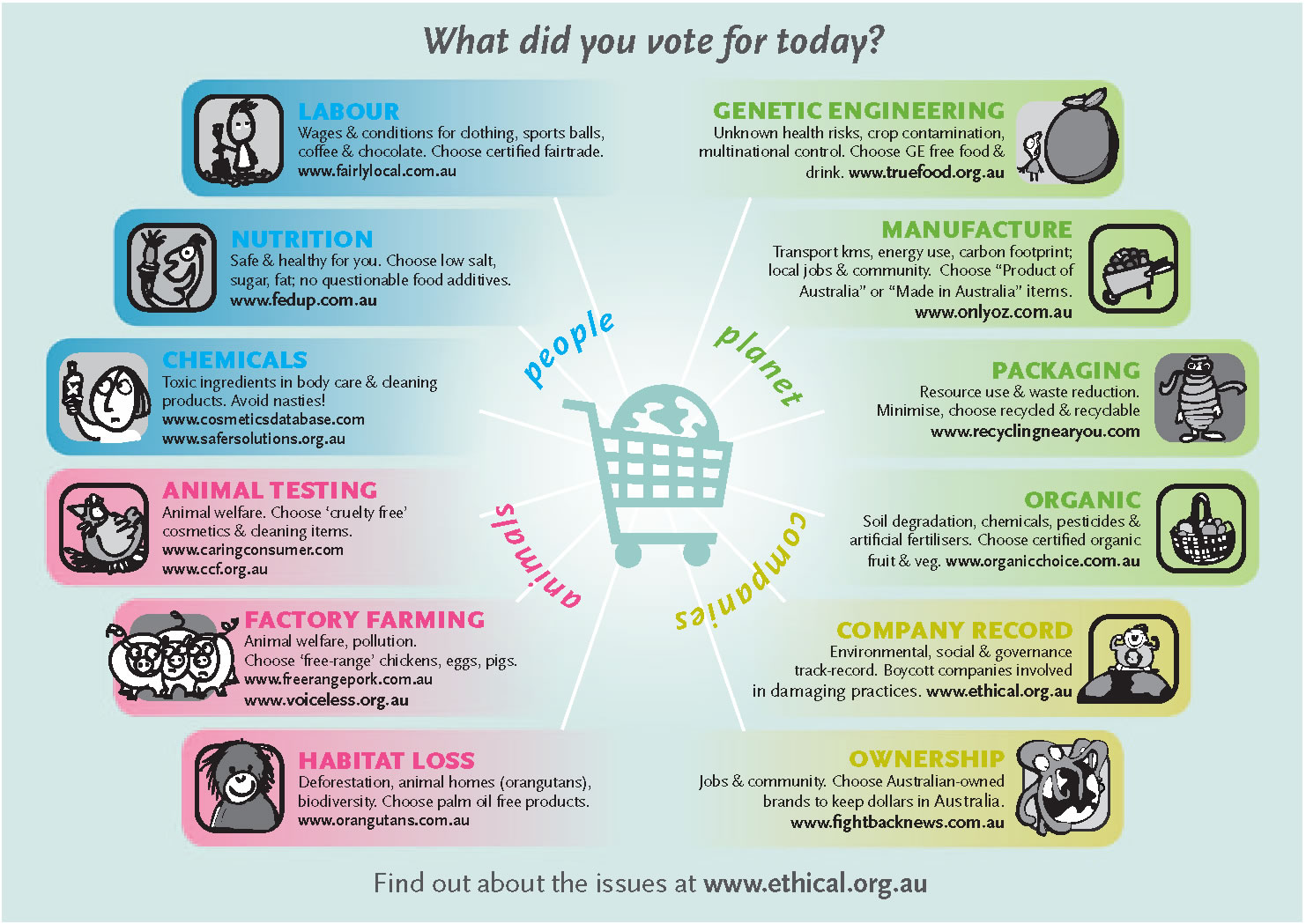
I'm a strong proponent of voting with my wallet. This is a general post about how I do that at the supermarket. There are many product categories available at supermarkets, each deserving of its own post (or series of posts) that I'll cover in future. These include food, toiletries and cosmetics, cleaning products, pharmaceuticals, clothing and textiles, and more.
I feel the two big supermarket chains in Australia have a real duopoly. (Gosh! I just googled it and Maggie Beer agrees in this article published online 30 minutes ago.) The "big two" lure us in with loyalty programs, loss leaders and discount fuel offers. They're big pushers of tobacco, alcohol and gambling. I try to shop at independent supermarkets, farmers markets, greengrocers, butchers and other independent retailers. When I do shop at the "fresh food people" or "down, down, prices are down" I'm careful to choose brands and products that I want to encourage them to stock more - local, Australian owned, organic and fair trade products. These products are usually found on the bottom or top shelf or inexplicably (in the case of organic hot chocolate and instant coffee), the "health food" aisle.
Making choices at the supermarket can be overwhelming. Packaged products are covered with all sorts of misleading labels trying to convince us of their health or environmental benefits. Marshmallows are "99% fat free"! Likewise, many "natural" products are neither healthy for us nor the environment. Many iconic Australian brands, like Vegemite and Tim Tams, are no longer Australian-owned. You may be boycotting Nestlé but not realise that they own Connoisseur ice cream (I can attest to this; the logo is very subtle).
One tool to assist supermarket decision-making is the Shop Ethical! app or its hardware form, the Guide to Ethical Supermarket Shopping book. I used the book before I had a smartphone but I find the app more convenient. I also get less weird stares from fellow shoppers. The app allows you to search for products via brand name or category. For each product, it offers information such as ownership, number of Australian employees, any boycotts, scores on various ethical shopping profiles, environmental pros and cons, treatment of employees and other ethical considerations. For each product, there is also an overall recommendation and you can quickly scroll through these for each product category. You can "favourite" products for quick reference.
I do not blindly follow the recommendations in the guide (eg sometimes I buy Green & Black organic cocoa, even though it is owned by Cadbury) but in most cases I agree with the recommendations and it makes my supermarket shopping much easier. If you don't follow the overall recommendations of the guide, there is enough information (and hyperlinks) to assist you in making your own decision about individual products.

Further reading:
Ethical Consumer Guide - the not for profit organisation responsible for the Shop Ethical! app
Dick Smith's Magazine of Forbidden Ideas "Censored by the Murdoch Press!"
Ausbuy, Australian Owned and Australian Made
Fair Trade Association, Australia and New Zealand
Australian Made, Australian Grown
Choice magazine's survey on country of origin labelling
This blog post is purely based on my opinion. I do not have any financial stakes in any of the companies or brands recommended and I am not affiliated with them, other than being a consumer.
I feel the two big supermarket chains in Australia have a real duopoly. (Gosh! I just googled it and Maggie Beer agrees in this article published online 30 minutes ago.) The "big two" lure us in with loyalty programs, loss leaders and discount fuel offers. They're big pushers of tobacco, alcohol and gambling. I try to shop at independent supermarkets, farmers markets, greengrocers, butchers and other independent retailers. When I do shop at the "fresh food people" or "down, down, prices are down" I'm careful to choose brands and products that I want to encourage them to stock more - local, Australian owned, organic and fair trade products. These products are usually found on the bottom or top shelf or inexplicably (in the case of organic hot chocolate and instant coffee), the "health food" aisle.
Making choices at the supermarket can be overwhelming. Packaged products are covered with all sorts of misleading labels trying to convince us of their health or environmental benefits. Marshmallows are "99% fat free"! Likewise, many "natural" products are neither healthy for us nor the environment. Many iconic Australian brands, like Vegemite and Tim Tams, are no longer Australian-owned. You may be boycotting Nestlé but not realise that they own Connoisseur ice cream (I can attest to this; the logo is very subtle).
One tool to assist supermarket decision-making is the Shop Ethical! app or its hardware form, the Guide to Ethical Supermarket Shopping book. I used the book before I had a smartphone but I find the app more convenient. I also get less weird stares from fellow shoppers. The app allows you to search for products via brand name or category. For each product, it offers information such as ownership, number of Australian employees, any boycotts, scores on various ethical shopping profiles, environmental pros and cons, treatment of employees and other ethical considerations. For each product, there is also an overall recommendation and you can quickly scroll through these for each product category. You can "favourite" products for quick reference.
I do not blindly follow the recommendations in the guide (eg sometimes I buy Green & Black organic cocoa, even though it is owned by Cadbury) but in most cases I agree with the recommendations and it makes my supermarket shopping much easier. If you don't follow the overall recommendations of the guide, there is enough information (and hyperlinks) to assist you in making your own decision about individual products.
Further reading:
Ethical Consumer Guide - the not for profit organisation responsible for the Shop Ethical! app
Dick Smith's Magazine of Forbidden Ideas "Censored by the Murdoch Press!"
Ausbuy, Australian Owned and Australian Made
Fair Trade Association, Australia and New Zealand
Australian Made, Australian Grown
Choice magazine's survey on country of origin labelling
This blog post is purely based on my opinion. I do not have any financial stakes in any of the companies or brands recommended and I am not affiliated with them, other than being a consumer.
Wednesday, October 24, 2012
How I save lives (and not by being a doctor)
I recently read somewhere (I can't remember where but I promise it's true) that we should not be modest about what we donate to charity but instead share the information (and our reasons for donating) so that others are shamed inspired to also donate what they can afford.
The "Charitable Giving Index" published today by the NAB (one of Australia's "big four" banks) analysed charitable donations made by credit card, BPAY or EFTPOS. Charities were divided into seven categories, with "Humanitarian Services" charities (such as World Vision, Oxfam and Red Cross) receiving the largest portion of donations (32%), followed by "Community Services and Children/Family", "Other", "Medical Research and Services", "Health and Disability", "Cancer" and "Animals and Environment".
The analysis also looked at the average charity spend per person by their postcode, looking at donations in dollar terms and as percentage of taxable income. The top 10 postcodes (i.e. those with the highest rate of donations as a percentage of taxable income) from my state, Western Australia , donated just 0.13% of their taxable income. This was worse than any other state or territory in Australia. Obviously, there are limitations to the analysis (eg cash donations aren't included nor are donations of time or services) but at face value, we residents of the boom state of WA can do much better.
Reading Peter Singer's book The Life You Can Save in 2009 motivated me to increase my personal charitable donations. Singer argues that we have a moral obligation to help solve world poverty. The premise is that most of us would not walk past a drowning person without trying to save them, but we allow thousands of impoverished people to die through our passivity, when we could save lives by donating a proportion of our income. (The Life You Can Save website offers suggestions as to the proportion of income you should donate, based on your income and country of residence.) Now, whenever I consider a purchase, I think to myself, "Could I do better by donating this money to humanitarian causes?" I'm far from perfect as I could definitely do more, I still have many treats, holidays and frivolous purchases, and I come from the privileged position of having a comfortable income, not having student debts and not having any dependents.
Since reading The Life You Can Save I have donated at least 5% of my income to charity, increasing the amount each year. This includes regular monthly donations to five charities (including Oxfam, MSF, Red Cross, Amnesty and a sponsor child) and one-off donations to other appeals, such as for disaster relief or if an acquaintance is fundraising for a particular cause (such as One Girl's Do It In A Dress). Not all of my donations go to humanitarian causes (some are medical charities such as the Cancer Council). I also donate to arts charities and scholarships at my university but do not include these in my 5% target. Sometimes, I may feel that I'm throwing money at charities to alleviate my First World guilt (or my lack of hands-on contributions to charities) but every bit helps and even one life saved or made more comfortable makes it worthwhile.
I'll do a longer post on The Life You Can Save (and its evidence-based suggestions as to which charities you should donate) in the future but for now will leave you with these reasons why I donate to charity:
Take The Life You Can Save pledge along with 14 000 other people.
The "Charitable Giving Index" published today by the NAB (one of Australia's "big four" banks) analysed charitable donations made by credit card, BPAY or EFTPOS. Charities were divided into seven categories, with "Humanitarian Services" charities (such as World Vision, Oxfam and Red Cross) receiving the largest portion of donations (32%), followed by "Community Services and Children/Family", "Other", "Medical Research and Services", "Health and Disability", "Cancer" and "Animals and Environment".
The analysis also looked at the average charity spend per person by their postcode, looking at donations in dollar terms and as percentage of taxable income. The top 10 postcodes (i.e. those with the highest rate of donations as a percentage of taxable income) from my state, Western Australia , donated just 0.13% of their taxable income. This was worse than any other state or territory in Australia. Obviously, there are limitations to the analysis (eg cash donations aren't included nor are donations of time or services) but at face value, we residents of the boom state of WA can do much better.
Reading Peter Singer's book The Life You Can Save in 2009 motivated me to increase my personal charitable donations. Singer argues that we have a moral obligation to help solve world poverty. The premise is that most of us would not walk past a drowning person without trying to save them, but we allow thousands of impoverished people to die through our passivity, when we could save lives by donating a proportion of our income. (The Life You Can Save website offers suggestions as to the proportion of income you should donate, based on your income and country of residence.) Now, whenever I consider a purchase, I think to myself, "Could I do better by donating this money to humanitarian causes?" I'm far from perfect as I could definitely do more, I still have many treats, holidays and frivolous purchases, and I come from the privileged position of having a comfortable income, not having student debts and not having any dependents.
Since reading The Life You Can Save I have donated at least 5% of my income to charity, increasing the amount each year. This includes regular monthly donations to five charities (including Oxfam, MSF, Red Cross, Amnesty and a sponsor child) and one-off donations to other appeals, such as for disaster relief or if an acquaintance is fundraising for a particular cause (such as One Girl's Do It In A Dress). Not all of my donations go to humanitarian causes (some are medical charities such as the Cancer Council). I also donate to arts charities and scholarships at my university but do not include these in my 5% target. Sometimes, I may feel that I'm throwing money at charities to alleviate my First World guilt (or my lack of hands-on contributions to charities) but every bit helps and even one life saved or made more comfortable makes it worthwhile.
I'll do a longer post on The Life You Can Save (and its evidence-based suggestions as to which charities you should donate) in the future but for now will leave you with these reasons why I donate to charity:
- I can improve more lives indirectly through supporting humanitarian charities than I can directly through working as a doctor;
- It is wrong not to; and
- It gives me a warm fuzzy feeling.
Take The Life You Can Save pledge along with 14 000 other people.
Saturday, October 20, 2012
Buy Nothing New Month - Resources
Following yesterday's post about Buy Nothing New Month, here are a few links to help get started:
- The Story of Stuff project - simple but powerful videos
- Naomi Klein's No Logo still resonates more than a decade after it was published - pick it up second hand or from the library
- Affluenza by Aussie Clive Hamilton
- Overdressed: The Shockingly High Price of Fashion Elizabeth Cline's book about the costs of cheap, imported, "throw-away" fashion
- Discardia: More Life, Less Stuff a website, a holiday and ironically, now a book
- The 100 Thing Challenge Dave Bruno's story about escaping the prison of American style consumerism
- Unconsumption blog for creative reuse and mindful consumption
- The Invisible Badge: Moving Past Conspicuous Consumption online presentation by Rob Walker
- Sarah Wilson's post on Buy Nothing New Month, with 20 tips on how to buy nothing new, including links to collaborative consumption sites like airbnb
- #buynothingnew on Twitter
- Many more inspiring links on the Buy Nothing New site
Friday, October 19, 2012
Buy Nothing New Month

"We used to build civilizations. Now we build shopping malls."
BILL BRYSON
"Consumers have not been told effectively enough that they have huge power and that purchasing and shopping involve a moral choice."
ANITA RODDICK, BODY SHOP FOUNDER
"Too many people spend money they haven’t earned, to buy things they don’t want, to impress people they don’t like."
WILL ROGER
"People used to die of consumption. Then it went from being a fatal disease to a way of life"
ANON
"Advertising has us chasing cars and clothes, working jobs we hate so we can buy shit we don’t need."
FIGHT CLUB, MOVIE BASED ON THE NOVEL BY CHUCK PALAHNIUK
ANON
"Advertising has us chasing cars and clothes, working jobs we hate so we can buy shit we don’t need."
FIGHT CLUB, MOVIE BASED ON THE NOVEL BY CHUCK PALAHNIUK
This October I am participating in Buy Nothing New Month, a movement for collective, conscientious consumption that began in Australia's shopping capital, Melbourne. I have pledged to buy nothing new this month, with the exception of food, drink and medications. I am allowed to buy second-hand goods and first-hand experiences. There are several reasons I decided to make the pledge. Firstly, to protest the rampant materialism that infests the developed world, making us selfish and numbing us to the plight of those who have less and those who suffer producing all our "stuff". Secondly, to raise awareness amongst my friends and colleagues about our wasteful lifestyles. Thirdly, to remind myself that just because something is ethically produced, it does not give me an excuse to buy it.
As someone who enjoys shopping (I will even confess to reading the inelegantly named Shop Til You Drop magazine), I thought that Buy Nothing New Month would be difficult. (I am particularly vulnerable to anything that's locally made, fair-trade, well-designed and from one of my favourite local independent stores - a particularly wanky kind of conspicuous consumption, I guess.) However, it has proven very easy thus far.
I thought that a weekend in Melbourne would be particularly challenging. Happily, I enjoyed my spare time dining with friends and colleagues and browsing the small galleries and second-hand stores of Fitzroy. My single non-food, non-transport purchase of the month is a 1946 edition of George Bernard Shaw's The Doctor's Dilemma, from antique and vintage store 84 Smith Street. I've wanted to read this play for a while (it advocates doctors being paid a fixed salary, without any financial incentive to offer unnecessary treatment to patients - more on that another time) and I was very pleased to find it for five dollars.

I thought that a friend's birthday gift might prove difficult but I found a gift that I had bought for him a couple of years ago and forgotten about (I have a drawer full of such purchases), which I delivered to him in Melbourne, wrapped in some reused tissue paper. The Buy Nothing New movement also suggests gifting experiences or second-hand goods (like antique jewellery)!
Although I have bought food when I'm eating out, for meals at home I've tried to use up things in my pantry that would otherwise probably sit there until they were inedible. Brinjal pickle with wholemeal couscous was quite tasty (although somewhat lacking in greens).
One thing I've observed is that when I stay at a hotel I am impeccable, aided by the small number of items I have with me. For the recent weekend in Melbourne, I used a handbag for luggage. For four days working in the Pilbara, a tiny wheeled suitcase was more than sufficient. This is in contrast to my cluttered, chaotic home, which is full of gifts I've never given, art I've never hung, books I've never read, DVDs I've never watched, stationery I've never used, half-empty toiletries, clothes I've forgotten I own, unused craft supplies, CDs I've never played, alcohol that has sat on the shelves for years (scandalous, I know), and unnecessary multiples of so many items that I couldn't name them all. During a particularly decadent phase a few years ago, I would buy new clothes when I ran out of clean clothes to wear to work. I didn't even realise I was doing it until my mother pointed it out to me.
What have I learned from Buy Nothing New Month so far? I've become more aware of things I want to purchase, don't really need, but justify by telling myself that I'm supporting a small business or an ethical producer. I've become more creative with food and outfit choices. I've picked native flowers from my mother's garden instead of buying bunches from the florist that usually die within a few days. I've been catching up on some of those unread books. I've halted the ridiculous flood of gifts for my 10-week-old niece. At no time have I thought twice about something I didn't buy, or rued a lost opportunity. I haven't wasted any time browsing department stores. I chose vintage stores over the discount mall patronised by my colleagues when we were in Melbourne.
I think I need to extend Buy Nothing New Month into Buy Nothing New Quarter. That would provide a real challenge and force new behaviours, such as joining the library, using up those craft and baking supplies for the holiday period, finishing those unread books, "shopping the closet" and getting old shoes repaired. I would spend more time creating, spending time with family, making my way through the never-ending "To Do" list and not accumulating stuff.
Who wants to join me?
See Part 2 for Buy Nothing New resources
Quotations above via Buy Nothing New Month website
Subscribe to:
Posts (Atom)